

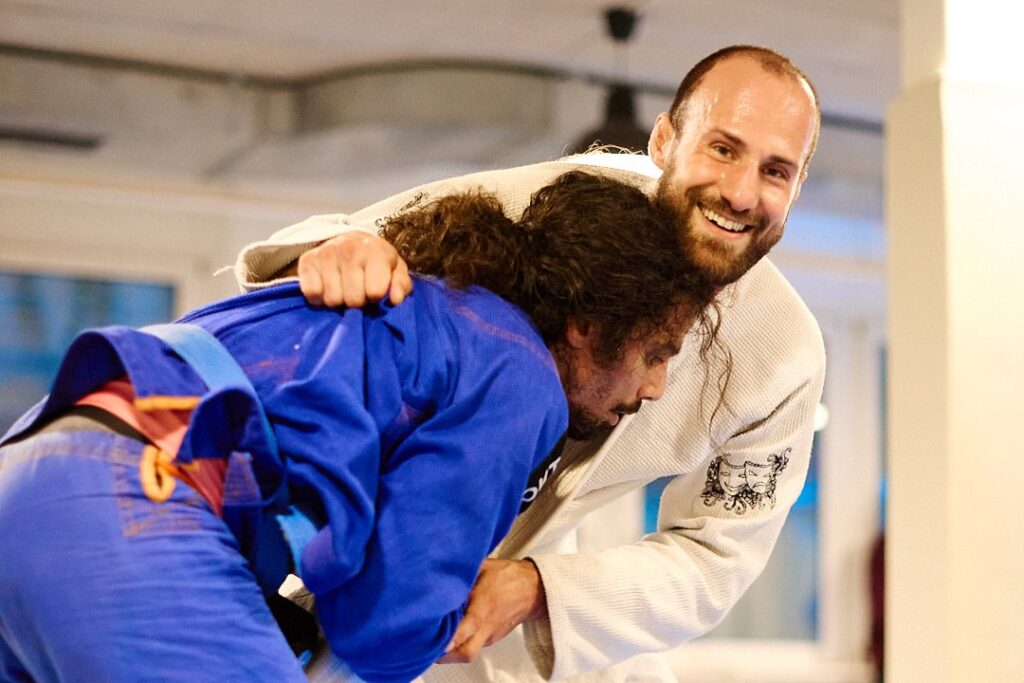
Why learning to slow down makes you faster, more precise and more lucid.
When you start Brazilian jiu-jitsu, everyone has the same reflex: go fast. Faster than the other person, stronger than them, before they can react. It makes sense. When you don’t really know what you’re doing yet, you make up for it with energy.
But there is a paradox I love helping people discover: to go fast, you first have to learn to slow down. And it’s not just a matter of technique. It’s a matter of attention.
Why everything speeds up
I see it on the mat in every session. As long as we work on a single movement, everything is fine. People take their time and look for their base. Nobody is out of breath.
As soon as we chain three or four steps together, everything changes. Movements get jerky, breathing races, people force and tense up. Very quickly, everyone is out of breath.
Yet the physical effort has barely changed. What has changed is the stress: more information to process, more decisions to make. So you speed up. And the more you speed up, the less you understand what you’re doing. I lose my bearings, so I rush. I rush, so I lose my bearings even more. It’s a bad shortcut.
Fast is not rushed
People often confuse the two. Someone who has mastered a movement can do it very fast without ever looking hurried: their base is there, they know where they’re going.
Rushing is something else: the body leaving before the head, the feet coming off the floor, the hands grabbing anything. A lot of activity, little control. At that moment, you’re no longer the one leading.
And in jiu-jitsu, that costs a lot. Every movement commits you. If you move without understanding, you can create the very opening the other person was waiting for.
The tunnel effect
Under pressure, your field of vision narrows. All you see is a small white ball at the end of the tunnel: the grip to get, the attack to finish, the position to escape. Everything else disappears. You no longer feel that your partner has shifted their weight, that they are already preparing something else.
The trap is that in the tunnel, you feel powerful. You feel like you’re going fast. But that feeling doesn’t mean you’re effective. Often you spend a lot of energy, move a lot, and make much worse decisions.
Slowing down on the inside
The opposite of the tunnel is slowing down on the inside. Careful: that doesn’t mean moving slowly. You can be in an intense roll, attacking, defending, changing direction, and stay calm inside. And you can be almost still and completely panicked.
When you slow down on the inside, you see that the other person is already coming back. You see where they’re going. You feel the pressure that announces a change of direction. You no longer need to chase every event: you start to see it coming.
That’s where it all happens. Slowing down doesn’t make your body faster: it makes you understand sooner. And when you understand sooner, one small well-placed movement does the job where three big rushed ones would have failed.
A battle between you and you
We think the hard part of jiu-jitsu is your partner’s resistance. It’s real, and it’s what makes this sport interesting. But very often, your number one opponent is you: the urge to win every exchange, the frustration when it doesn’t work, the excitement that pushes you to speed up.
On the mat, you meet these reactions in every session. And you discover that you don’t have to obey them.
Why we train slowly at the club
That’s why in class I often ask people to slow down. Not because jiu-jitsu is slow, quite the opposite. Because speed hides a lot: you can make a movement work with momentum or strength without understanding how.
When you slow down, everything becomes visible. You feel where your weight is, the moment you lose your balance. You discover that a movement that seemed to need strength works with much less effort when your base is right.
In these drills, the instruction is simple: you can increase the intensity, not the speed. Your partner resists, stays present and gives you information: you simply take the time to receive it. Sometimes even with your eyes closed. Not to look good: to feel what speed stops you from noticing.
Speed then comes back on its own. You see it in experienced practitioners: they sometimes move less than their partner, but they arrive in the right place at the right time. Not thanks to an extraordinary physique, but because they recognise the situation. Speed becomes a consequence of learning, not a goal. There is no shortcut.
And off the mat
The best part is that it doesn’t stay on the mat. A conversation that gets tense, a situation slipping away, the pressure to answer right now: the tunnel shows up in life too.
Jiu-jitsu doesn’t solve everything. But it trains you to recognise the moment you start rushing. And to choose something else: take a moment, find your base again, look at what is really happening.
Slowing down to go faster isn’t about doing things gently. It’s about no longer confusing the urge to act with the need to act.