

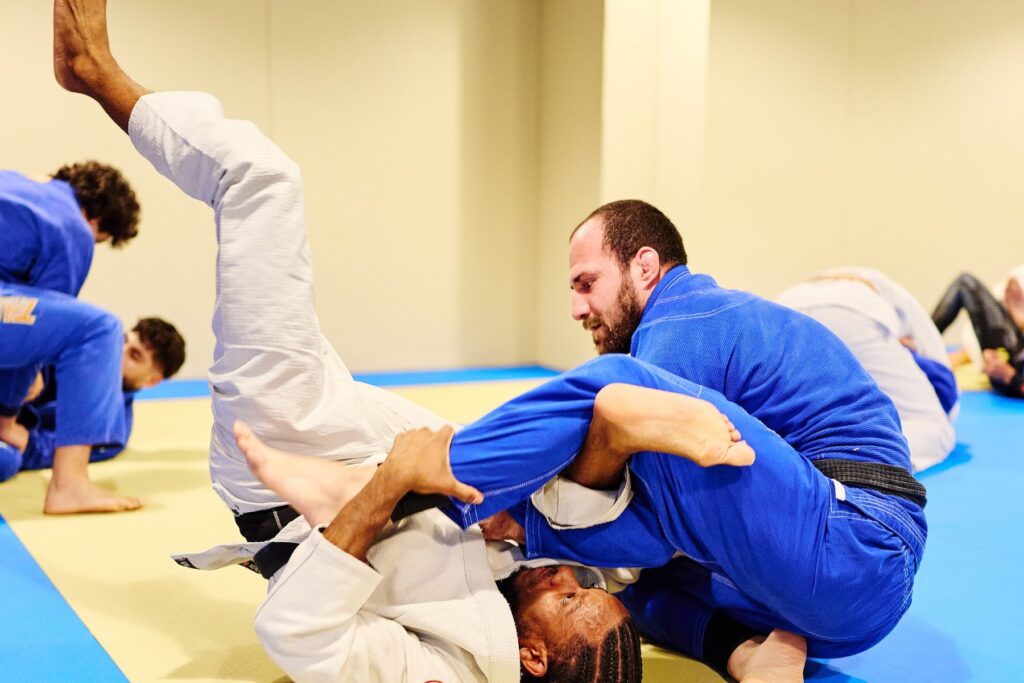
What if learning to fight were also learning to listen?
When you watch two people doing Brazilian jiu-jitsu, you see attacks, defences, pins. Two people trying to get the upper hand.
When I’m on the mat, I see something else: a conversation.
We imagine a roll as a six-minute block. To me, it’s about a hundred exchanges. I do something, you react. You take the initiative, I adapt. This conversation doesn’t happen through words, but through base, pressure, tension and release. It never stops.
Each person has their own agenda: you want to pass my guard, I don’t want you to. We don’t share the same goal, and yet we build something together. One day a student told me: “It’s like a dance.” Exactly. Except that in a dance, you agree on the direction. Here, you don’t. And that’s what makes the conversation interesting.
Getting out of the snowball
When you start, everything goes too fast. You try something, it doesn’t work. The other person moves, you lose your balance, you end up underneath. You try to get out, a new problem appears. Everything piles up: that’s the snowball. You no longer understand what’s happening, so you react in a panic. And the more you react in a panic, the less you observe.
A big part of my work is putting steps back where the student only sees an avalanche. Am I open or closed? Am I moving forward or settled? Am I attacking or defending? Should I act now, or wait?
These questions look simple. They change everything. The roll becomes a series of small problems to solve, rather than one big problem to endure. Six minutes is no longer a block. It’s a series of exchanges lasting a few seconds each, one small step after another.
Listening before answering
In a conversation, listening isn’t waiting for your turn to speak. It’s trying to understand what the other person is saying.
On the mat, it’s the same. If they push, where do they want to go? If they pull, what are they trying to provoke? If they tense up, they’re preparing an effort. And sometimes the best answer isn’t to oppose them: it’s to go with them, go around, let it pass or wait. That’s not being passive. You have to be very attentive to see these opportunities.
That’s one of the great riches of jiu-jitsu: working with what the other person gives you, rather than forcing on them what you had planned.
Choosing which game you play
The conversation also happens through intensity. Picture two people arguing: one raises their voice, the other answers a little louder, and both escalate without noticing. On the mat, it’s the same. They speed up, you speed up. They force, you force. And in the end you’re rolling at an intensity neither of you chose.
Yet you always have a choice: play their game, or say “no, that’s not the game I want to play”. Change the rhythm, move differently, look for another solution.
Facing someone very wound up, staying soft isn’t always enough. Sometimes you need to step up slightly, just enough to say “I’m here too”, without ever going above them. Then come back down. And very often, the other person comes back down with you. I love watching that: two people adjusting their intensity to each other, sometimes without even realising it.
There is no one-way street
There’s a rule I often repeat: if you move, I move. If I pin you, I pin myself too.
We are linked by contact. To control you, I have to commit too. To stop you from moving, I accept giving up part of my own freedom. Every action opens some possibilities and closes others.
That’s why I don’t see jiu-jitsu as a collection of techniques. A technique only makes sense in a given situation. What interests me isn’t that you can copy a movement: it’s that you understand why you do it, and when. Learning jiu-jitsu is learning to read this conversation, then taking part in it more and more consciously.
The mat doesn’t lie
Maybe that’s why I love this sport so much. On the mat, people talk little, but they express a lot. When someone is angry, you feel it. When they’re exhausted, they can’t lie. When they start to trust, you feel that too.
The mat puts you face to face with how you handle failure, your need for control, the way you react to pressure. It’s a place of truth, where you meet the other person as much as yourself.
At a time when we find it so hard to listen to each other and to communicate without needing to be right straight away, I find that precious. Two people can have opposite goals, resist each other honestly, and share a real moment of respect. You can oppose someone without being enemies. You can roll seriously, intensely, and go home with a smile.